Showing posts with label DM tips. Show all posts

Sunday, January 16, 2022

Cutscenes

 I’ve spoken about stealing from Mörk Borg and Mouseguard — now it is Starforged. In Starforged:


Cutscenes can reveal a lot about your game.  They can show how a faction or town views the players.  For example, as a party leaves a town after completing good deeds, perhaps a toast is held in their honor at the tavern—where potentially a less than honorable individual sits in silence, taking the information in.  Or the tavern patrons could all state how lucky they were the PC’s came—and they hope only to return the favor (setting up for a possible deus ex machina down the road).

Cutscenes also highlight tone. While gameplay should be reinforcing the tone of your game, having cutscenes are like that edge highlight in a miniature—bringing additional attention to a specific point. A grim world where things do not improve, even with the party’s help, can be reinforced by a cutscene of the rescued town falling back into ruin the moment the party rides off to their next goal.

Finally, cutscenes can be used to set up future mysteries. My main advice for cutscenes is they should be non-interactable by the party nor should they be immediately relevant. They can be—and this can work—but by having cutscenes pay off a session or two later builds apprehension in players.  Compare it to the “in the coming weeks” segment for TV shows on a weekly schedule.

The common critique against cutscenes is “then the players have meta knowledge!”

So what?

Starforged is almost always played solo.  Meaning, I have the meta knowledge whether I discuss the cutscene out loud or not.  That doesn’t reduce my enjoyment.  Rather, it focuses my attention on the world around my character and how the world is reacting to my actions or just progressing along. Metaknowledge can also be mitigated.  Don’t have your villain exposit their *entire plan—*instead do a cutscene where a lieutenant informs them that the heroes have taken X action and the villain responds: “hmm that will set me back, but no matter, we must advance to phase two sooner than I thought.”  Now that is obviously devoid of flavor, but the barebones concept stands.

Try opening or closing your session with a cutscene and let me know if you/your players like it!

Thursday, December 23, 2021

Index Card Maps

I am not very creative.  A lot of my solutions involve seeing what other people do, and constantly trying new stuff.  If it doesn't work - no stress - just try something else. 

I do have an amazing strategy on how to design maps with index cards.  I wish I could attribute this to someone, as I cannot imagine I am the first to do this - but hopefully I'll at least be the first to suggest it to you!

Here is a tavern:


Then you can place a die, maker, or minis for each player in that card to show - you are here.  It is easy to expand with additional cards if they head in a direction or split up.  I think the cards encourage splitting the party in towns - which I love.  I actively suggest each PC go where they want to in town and say "hey this is an option."  It is important not to punish this split - but that's another blog topic I want to do.

Index card maps allow for a ton of flexibility if players go in a direction not immediately planned because it doesn't reveal you didn't consider the player's path.  This increases immersion to me.  It also harkens back to old rogue-likes or CRPGs! It can be done beyond just towns

Oh and it is substantially less to bring to a table if you're traveling to a game store or player's house.

Try it out sometime!

Tuesday, November 23, 2021

On Dying


Bless me Gygax for I have sinned. I kinda dislike dying at 0. Or dying at -10. And death saving throws. Good lord death savings throws are the worst.

These options are missing 2 key elements:

1) Drama:

    In a game style (DCC) where characters are supposed to go through a funnel-death at 0 is a perfect mechanic to match the fiction. In other tones, even the pithy ratcatcher style games, I don't think death at 0 adds drama or tension. There is some - as a player hits 1-3 hp and everyone knows that the next hit is the last. But that tension is fleeting and immediately "resolved" once death occurs. Also most characters in those style games only have 5-10hp to begin with - which means they are always on deaths door.

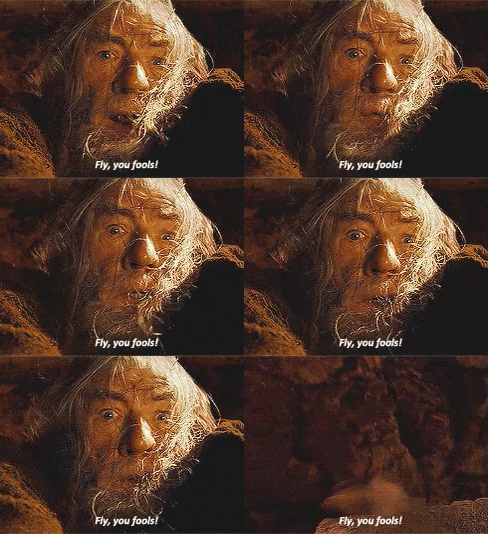
    But the main drama it fails to capture is a well loved trope - "fly you fools.gif".


    The heroic sacrifice. Death at 0 does not really allow a player to turn to their friends and make a Gandalf style proclamation. Whether that often is "allowed" to play out at tables is another conversation (see Matt Colville's video on Surrender) - but it is a fantasy that should be engageable with. Players don't like running away - but they hate leaving someone behind even more. Plus that requires consensus which is even more unlikely in that situation. But if someone is going to die - no way to prevent it - then they are able to do a heroic sacrifice without other players attempting to aid their character.

2) Player Engagement:

    This is more of a knock against death saves (ala 5e) - which is the player is in a state of "not playing." I think being knocked out is valuable, and should increase tension - but if turn lengths are anything longer than a few minutes - than tension begins to dwindle.

    This is very much not to say that turn skip mechanics should not exist - they should - but they should create proportionally more tension or drama. I'd also argue that player engagement gets in a weird space when a character dies early in a session. Even if character gen is simple, engagement can drop unless there is an obvious party recruitment method planned or baked into the current adventure. That can also place stress on the DM (getting the player back in the action).

Solution:

    Lol. If I had the perfect solution to death, I'd be writing a game system built around it. I've tried a lot of solutions and so far none have captured what I'm looking for. I think something would require a lingering injury table, but then not taking them out of the fight. I also like the idea that once a character dies - they continue through the fight. But survival is not an option once combat ceases. Similarly, something to where the player hitting 0 receives a mortal wound and will not leave the dungeon alive allows some fun exploration of those tropes. I'm not sure how to graft that onto a ttrpg mechanic though.

    Maybe a system as seen in the board game Eldritch Horror where no character "dies." But once at 0 hp or sanity they retire because their injuries are just too great to attempt to fight the horrors of the world. I like where Knave 2.0 is going - where any spill over from your hp is taken as injuries which begin to fill up inventory slots. At 0 inventory slots - death occurs. In abstract this really isn't very different - but it does feel different.

    If anyone has any suggestions especially ones that have an attempted solution to enable heroic sacrifices please share!

Thursday, March 11, 2021

Naming the Party


Everyone agrees a +1 sword—without anything more—is dull.

Everyone agrees a dungeon—without flavor—is boring.

So why does the Party not have a name?


Giving the Party a name is similar to wielding "The Sunblade" or delving into "The Tomb of the Serpent Kings." It contains a wow factor.

There are plenty of ttrpg groups that stream with party names.

  • Critical Role has Vox Machina and The Mighty Nine
  • Acquisitions Incorporated
  • MCDM has The Chain, The Revenant Vow, The Shield of Gravesfold
  • and there are many many more examples.

Naming the Party has some amazing benefits such as:

  • Increased Group Unity (there is now a clearer defined "us")
  • Ability to confer rewards that are unique to the Party (ex. +to charisma checks or bonuses to reaction rolls against those who have heard of the Party's accomplishments).
  • Provide an easy in game reason for a new PC to seek the group out in the event of a player character death

Despite so many indications that there is power in a name, I don't think it is a prevailing part of gaming culture.

There is definitely pressure on a group to pick "the right name." A DM could also worry the players won't take the matter seriously and chose something like "Power Rangers" or "The Mighty Five." These types of names could ruin immersion in something other than a beer & pretzels style game. Fear over this does not mean you should instantly dismiss the concept. I think there are two strong starting options to guide towards a name—although I'm sure more are available to those with more creativity.


Team Unity 10/10 — Go go name the party! 

  1. The Skyrim Cart
  • Have the campaign begin by the characters selecting their name. They can be in a tavern if you like tradition. I've done this on a boat, sailing into the "starting city." Actually I've done this a few times starting on a boat . . . what can I say? If it works it works. The players are together for whatever reason you've determined in session 0. Maybe they are friends setting off for adventure! Maybe an organization? Maybe just a band of adventurers? Regardless, the populace is more apt to spread the word on whatever deeds the Party achieves if there is a name to associate them with. Regardless, once the name is selected—something should just HAPPEN. Orcs attack! A tavern brawl breaks out! The kraken surfaces and threatens to drag them down to the depths!  Reward the achievement of unity by having a big set piece. 
  1. The Indiana Jones
  • Start the players in a situation where the need to accomplish something before returning to town (or their safe haven).  It should be open ended enough where the players have a ton of freedom on how to respond with their starting goals.  This might be a good spot to introduce a secondary antagonist or the primary antagonist's lieutenant (maybe not in a combat encounter, just talking between the bars of a portcullis!).  The Party can then return to town successful (perhaps not 100% success, even Indy lost to Belloq) and a town guard could ask "Wow great work, what do you call yourselves?" The players now have an event to base their decision off of—something to help spark ideas.

Either way, the DM should give the players an opportunity to discuss things and even feel free to chime in and guide some discussion. If the DM hears a good idea—say so!  This can help the players feel reassured in their decision.  Additionally, the entire table should feel some degree of comfortableness (is this even a word?) with the name.  This includes the DM. 

The name should also be reinforced through repetition. NPC's should use the name. Comment on it. And love it.  The reinforcement should be that the name is good and that the name is important. This also goes for antagonists. I would not recommend "making fun of" the name—as you risk the players feeling like it was dumb to put themselves out there.  

Finally I want to comment on the idea that the players will not unify.  This is not a problem that results because you asked for a group namerom.  This may be a problem with the player's group dynamic.  Being able to see this and discuss solutions as soon as possible will result in less future problems.  If they players aren't going to play nice together, then perhaps a boardgame is a better option?  Or a different group? 

Having these discussions can also reveal characters that will not gel together.  This is probably a tangent for a session 0 blog, but simply giving the group a similar goal does not mean the characters will mesh.  Depending on the prevalence of inter-party roleplay, the conflict may not even arise until well into the game.  If they can't compromise on a name—they will not be able to compromise during any major point of tension.  And that is something I would want to know as soon as possible.

That's my thoughts, really trying to get back into blogging, not sure what topic I have in me next—maybe a reaction to a zine I recently read ("Barrow Keep") or discussing death at 0 hp and death saving throws.

Wednesday, March 10, 2021

The Usefulness of Narrow Hallways

Short blog post—having a lot of inspiration and want to keep the magic rolling! 

Today I want to highlight the usefulness of using hallways that are only five feet (one movemenet square) wide.


It is actually pretty telling how many iconic fight scenes take place in narrow hallways

The first time I built a dungeon that contained a long narrow hallway with a few attached rooms (ala The Raid), my more tactical players were very very frustrated. They didn't feel they had room to maneuver or make "interesting" combat decisions. Instead, they fought a mind flayer in an exceedingly awkward manner.  The door to a room was held by a corpse piloted by an intellect devoured corpse and the mind flayer comfortably stayed back—firing psychic blasts.  The Party was overwhelmingly melee based and were blocking each other from attacking anything.  It was chaos.

One character died and it was the closest I've even been to having a TPK.  

Afterwards, some of my players commented that they wished the hallways were simply 10 feet wide to allow them to have "options for tactics." Oh, and the doors should have been 10 feet wide. That way the Party could just pass through and hit the mind flayer.

I disagree.

Not every dungeon (read: space where combat could occur) was designed for combat. Think about how many narrow hallways some buildings have.  There are numerous reasons that those hallways were built that way. This should signal that this area is something different. Something that just doing the bog-standard attack action will place you at a disadvantage.  It is akin to fighting during inclement weather, in an anti-magic sphere location, or other obstacles that force a tactic change. The Party should never be able to use the same operating procedure in every fight.  There is no drama to be had there.

One way to prevent that—is to prevent their movement.

This fight is made much more tense because of the narrow cramped hallways!

Sometimes you want the Party to be cramped. Create the feeling that progressing forward means marching order matters.  Sure this can be handled through traps, but fights also spice things up. 

Monsters should also take advantage of this. After all, the dungeon is their home. It should reflect their lifestyle.  For example, a dragon whose breath comes in a line may have a hallway of similar dimensions to pre-attack the Party before they reach its lair. Just a opening salvo. To scare away (or potential kill) intruders.  Sure the Party could heal and recover from any damage taken.  But a message is sent.  The dungeon is hostile. 

All that said: use narrow hallways!  Make the dungeon space hostile to force tactic changes even if the players may initially feel frustrations thier standard operating procedure is disrupted.  Finally, keep in mind that whatever dwells in that space should use it to their advantage!

Monday, March 8, 2021

Make Experience Points Work for You

Best Advice Upfront: A DM should use an experience point system to incentivize the playstyle(s) they want to see in the game.

Experience points are a perfect carrot to guide players towards the DM's "favored" playstyle. The players always reflect their style by making choices and decisions while the DM can provides mechanical "rewards" for making those choices within a certain style. Viewed this way, it is a great way for a table to form a solid middle ground of how the game will be played.

I won't rant on why I dislike milestone leveling. I only mention it is because it rarely communicates to the players what playstyle will get rewarded. If the milestones are hidden behind the DM screen, players can begin to feel like they are trying to just guess at what the DM wants to happen.

A lot of OSR games do experience for gold. This is fine. It conveys the goal of the game is to go where there is gold and obtain it.  You probably won't have a high level of roleplaying (or at least—less) as it is not rewarded. Only pursuit of profit matters. 

[sidenote: "Only pursuit of profit matters" actually sounds like a fun style of game ala Acquisitions Incorporated]

That being said,  experience for gold doesn't do it for my OSR game.  I want to reward roleplay, making decisions in character, and the players preplanning the next session. I still want dungeons, so obtaining gold is also important.  But just recovering it isn't my main intention.

My DM, (@Painted_Squid on twitter, seriously check him out) began implementing the experience system from Mouse Guard in 5th Edition. Mouseguard gives experience for acting on your beliefs, acting on your trait, and accomplishing your goal. Over time he's made numerous adjustments to have it mesh with 5e and I hope at some point he publishes his trial-and-error thoughts because wow.

With all that in mind, here is my experience system using the mouseguard framework! Experience is calculated at the end of session, with achievement being a binary "if yes, then xp."

  • 1 xp per 1 Gold Spent

    • I want the party to go to dangerous places were they can find gold. But I don't want it hoarded. Thus, make them spend the gold. All my players started in 5th Edition with milestone leveling. Specifically, the epic quest milestone system. They never focused on acquiring titles, improving property, or having hirelings to perform services. In a game where those assumptions are shared by all players, just xp for acquiring gold might be okay.
  • 100 xp for Acting on Their Trait (once per session)

    • A characters should have a consistent and flavorful personality. This rewards players who embody their characters trait during the game.  I generally dislike someone who just RP's as the best version of themselves. I also want to draw players towards a better understanding of each others characters. If someone writes "bashful" as their trait, any RP done by that player will be more easily received as being "bashful" —without needing the skill required to audition for Critical Role. It also allows the table to reflect on choices and RP done by all players, as this review is performed at the end of a session. The constant session to session affirmation of a players personality is further reinforcement. I have another blog post in me re: traits, but I'll save that for another time.
  • 100 xp for Accomplishing Their Goal

    • At the end of a session, I have my players fill out a single goal they would like to accomplish next session. It must have a "will they/won't they" element. I'm not always super strict on this because the true purpose of this is for me to vaguely plan next session without having feeling unprepared. This doesn't mean they are beholden to these goals & if something comes up that changes their direction I'm not upset. But I can at least know my pre-session prep is generally covering what they are intending to do, In a pure sandbox game with no "overarching plot," I would be nervous if I had little clue or insight into their plans, as games on VTT's come with certain expectations regarding battlemaps and other visual aids.
  • 3 Awards, Each Worth 100 xp: Best RP/Overall RP/MVP

    • I don't want the number of awards to equal the player count. This is because they are not meant to be just divided equally. I want players to want these. If everyone gets them, then they are glossed over and have no impact. That being said, if the players tacitly (never said verbally) ensure no one gets two and the xp is usually divided around the players, I'm not stressed. The purpose of this is still fulfilled.
    • Lastly, It does favor some players over others initially. It is true that the more outgoing people are likely to get awards for RP. However, it can also be used to highlight players who display more subtle or unrecognized RP. Being rewards could even encourage that player to feel more comfortable occasionally RP'ing in more outgoing fashion.
    • People like awards and the feeling of being recognized. This gives players the opportunity to be recognized at the end of a session. It turns into a mini recap in a way of things the players found important. They are purposefully vague to allow the players to reward activity that they enjoy that other players did in the session. Sometimes, I also weigh in if I think a moment was subtle or particularly impactful to me. The term "MVP" may seem loaded, but it is intended to cover a player who "provides a critical contribution to allow the party to progress." My current players understand this terminology, but I could see the being a future point of change.
  • 50 xp for Initiating a Chat Message to Another PC While In-Character (once per session)

    • This reward I'm not sold on yet—but it serves a small purpose. Part of why I love in-person games is the side conversations. It reduces pressure on me as a DM because I can resolve an individual's situation while other players plan or RP. Online games lack this mechanic unless you have breakout rooms—which are tedious and more work. For an in-person game this would be cut.
  • 1 xp for a New Character per 1 Gold Spent on the Dead PC Funeral

    • Dying sucks. It can be dramatic, intense, and worthwhile. But at the end of the day—that player's progression is reset. This rule is intended to help with the suck. The other goal it accomplishes is to prevent the other players at the table from "moving on" quickly. Too often at the table I've seen a player die and then feel like their death had no meaning for the other players. I don't think anything will cause another player to feel the loss in the way the player whose character died wants them to feel. However, with a mechanic designed to honor the fallen, there can be a moment to talk about the fallen reverently knowing this will power up the new party member. 
    • It also makes sense in universe. More powerful people are going to want to work with/travel with those who honor their dead with opulence. It shows to the world that the Party is successful (acquiring lots of gold and not feeling financially insecure to spent it). It also provides an opportunity for the new character to be introduced. For example, "I'm sorry to hear about your friend, . . . are you looking for a hand to accomplish XYZ?"

This is a work-in-progress and likely will never be finished. But I hope it inspires others to try to tweak and experiment with experience points.


Wednesday, January 27, 2021

Give Your World Consequences — Using the MÖRK BORG Prophecy System

Today I want to highlight a "hidden" mechanic in MÖRK BORG—the Prophecy system.

To sum it up: the DM rolls their chosen dice (1d2,1d6,1d10, etc.) at dawn.  If it is a 1, the prophecy advances and some terrible events sweep the land.  This escalates with each 1 until the 7th 1 is rolled where the DM is told: "the game and your lives end here. Burn this book."


Wow.

That is Metal.

Not only is that thematic and bold—but it addresses something I think is missing from modern day ttrpg DM session prep.  Fun.  Sitting down and just typing up notes is a quick way for me to feel that prep is a chore—which hurts my interest in getting ready for the game.  Using the Prophecy system, each time I prep (assuming the sessions generally begin at dawn) I get to play a micro game.  Does the world get worse?  

Now I am not advocating for every DM to build in an objective time their world violently ends.  But this mechanic can be ported to encompass anything that the players do not have control over. |That is something very important—the players cannot have control over the advancement.  For a setting to feel "real," things need to be happening in a way that the players cannot influence.  For example, they cannot solve the B plot while they focus on the A plot.  A DM could easily tie this mechanic to a D plot.  Some event that they are personally interested in seeing what happens but the players have not made the focus on the adventure.  

In my Old School Essentials game, the King will die on the seventh 1.  His death will drastically change the state of the world.  One through six will usher in events leading up to that situation that also are felt no matter where the players may be.  The events will not be anything that commands player action.  Similar to MÖRK BORG's world ending, the players cannot influence the death of the king.  It is inevitable.  What makes this a wonderful tool for DM's is that the level of unpredictability leads me to be excited to prep!  Is this the day the third 1 is rolled?  Whew it is not—the Party will wake without there having been a new disaster in the world.

This mechanic also increases verisimilitude.  Often RPG forums frequently tell new and experienced DM's to give the players "consequences" for their inactions to show that the world is moving.  "The clock is always ticking!" many say, without any further detail into making that just more work for a DM.  Employing "Prophecies" [read: any world changing consequence that is going to happen, it doesn't need to be an actual prophecy] sets triggers that will occur in the world ahead of time.  

With their timing being sudorandom, even the DM cannot initially prep for them.  This means you cannot preset your expectations.  If you know ahead of time all birds stop flying on the 5th day of the campaign, all your prep for days 1-4 will reflect that knowledge.  But if you prep 1-4 like "normal" sessions and then the 5th day comes, a 1 is rolled, and the birds lose flight.  That is engaging.  That generates new interest in the world and can take the story in a direction you would not have otherwise considered.  Because the players need to hear/see the worsening situation.  Even if they are deep unground, they have to find out on that day the birds no longer fly.

Now I want to briefly mention that this "gamification" of DM prep is not just seen in MÖRK BORG.  Stars/Worlds Without Number adds the GM turn—where the factions get to act and influence the world.  This takes a little more work for the DM to prep during the worldbuilding stage, but is also super useful.  Random tables get close to achieving the gamification ideal in helping break the rut of generic prep and to jumpstart creativity.

I have yet to play or read its rules in earnest, so a review is still a ways a way!  I just wanted to highlight a mechanic that I feel could go unnoticed.  Add tools to your game that allows the preparation to be a soloRPG that you run for you.  It will get you more excited for your sessions and take the story/setting in ways that you might not have imagined.  It may also be the key to help you push through the times where you lack motivation.


As a quick aside—ZineQuest 3 is coming up next week!  It is such a great time to celebrate the indie developers in the ttrpg scene who continue to put out amazing products.  I will certainly try to make a post discussing some of the gems but there are many other bloggers—such as Thought Eater (https://frothsofdnd.blogspot.com) and Pandatheist (https://boneboxchant.wordpress.com/) who are covering the available products in a much more comprehensive manner.  Check them out! 


Monday, November 23, 2020

Say Their Name(s)

Often on DM forums - I read a lot regarding players failing to engage with the game.  This is a problem that I struggle with from time to time.  Be it real or imagined - sometimes it does not feel like the players are upholding their end of the social contract.  Too often this blame gets laid at the feet of DM's - who often are expected to produce critical role -esque NPC's, stories, and encounters - without having players put in similar effort.  That rant is too long for the post I imagined today, so I'll shelve that for a later discussion. 

But I will offer a tool to increase engagement that requires no prep and no production quality. 

Say their names.


No - not my name. Their names. 

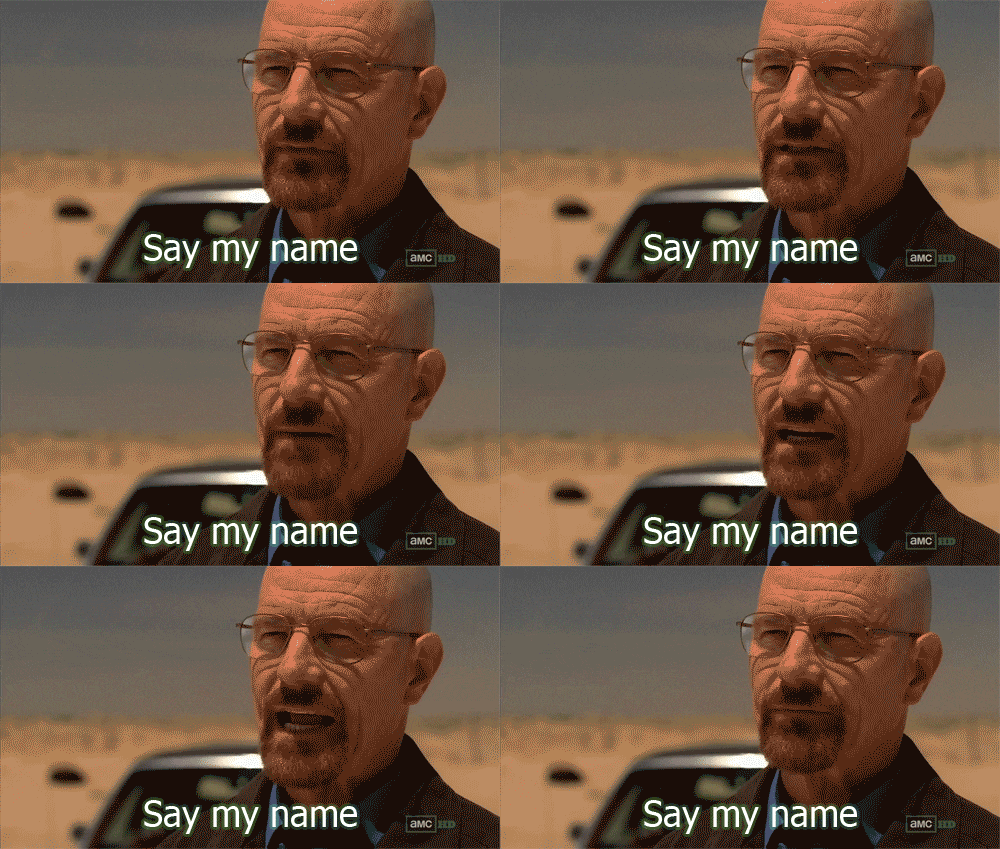
Nothing commands more attention turning to Zynn the Paladin and stating: "the farmer turns to you and asks 'I need you. I need you Zynn.'"  Bam.  At that point - the player is compelled to acknowledge being addressed directly and by name.  More importantly, their response must come from their character.  It is not John the engineer but Mav, the Fighter who must respond.  It also makes the characters feel powerful - like they are main characters in an epic movie.  Which, they often are! 

This works especially good when hard decisions are thrust upon them.  "Will you not fight for us, Spira of the Elfenwode?"  

This tactic is something that - like all good tools - should be carefully monitored to ensure it is not overused.  You wouldn't want to devalue the moment.  It also places a great deal of pressure on that one player - as all eyes turn to them.  Even still - when you feel engagement is low during a conversation with an NPC or if you just want to ratchet up the tension - just remember: Say their names. 


2024 Goal Progress

 It has been 9 days and I'm already posting an update!  Played ttrpgs: 2/24  Worlds Without Number* Mythic Bastionland^ Fox Curios: Floa...