Showing posts with label General. Show all posts

Sunday, December 24, 2023

What I'm Currently Reading, All Snug In My Bed

 Short post given it is Christmas Eve! 


I'll have a longer follow up in the next few days outlining what I'm hoping to accomplish in 2024 and a year in review for what I have read & played—but I wanted to give a shout out to a few books that are sitting next to me: 


Fox Curios Floating Bookshop: Really well written solo journaling game that has one of the best layouts I've ever seen [more on this book on a later post].  I've played out ~10 in game days.  I usually am not into journaling games—but the layout really pushes me forward and sets up evocative prompts. 

Delta Green:  I bought this on a whim a while ago due to the really great cover art (I'm a sucker for good cover art).  I don't know yet if I would run it, mostly because I don't think my main play group is a good fit, but it is a really interesting read. 

Redwall: I forget how much I love this book, although I don't think I've ever made it past Mattimeo.  Also a easy book to listen to and paint. 

Black Company:  Casually rereading this as I was listening to a lot of the older MCDM videos during a few recent long drives.


Monday, December 4, 2023

PAX Unplugged 2023

Just got back from PAX Unplugged yesterday and—despite being absolutely exhausted—I cannot wait to go back again next year.


As I mentioned in my previous post, I got to play and run a few ttrpgs. I also got to meet a lot of really nice people who share in my love of this wonderful hobby. I'll post below a quick review summary of what I played:

Mythic Bastionland (DM'd; 5 players): 2d6=11. Flavor is amazing and the mechanics reinforce the theme perfectly. My only complaint would be running for 5 made the combat swing easier than I think it is intended—thought I bet with a second crack at the apple I think I could solve that.


The Walking Dead (Player, 6 players) 2d6 = 7. The d6 pool and stress dice mechanic incentivizing "push your luck" was a lot of fun. A lot of the mechanics I didn't see (such as the growing horde) because it was the starter set adventure so I can't comment on that. I didn't like the theme, though I might have 10 years ago. The game also seemed to really want to push player relationship conflict. Which is very apropos with the themes in the show and comic.

Dragonbane (Player; 3 players) 2d6 = 5. I would describe my experience with Dragonbane as PF2e with ducks? Mallards? I don't know. I really don't get the Mallard thing. On topic: too crunchy and I didn't really feel like I understood what those mechanics were trying to reinforce. The starter set adventure I played was a dungeon crawl—but with no tactical room to move and an absurdly deadly/railroady boss. There were some cool mechanics, such as the fact the DM doesn't roll to hit. But I think I would sooner reach for 5e.

I guess at some point I should explain the 2d6 review scale so that it looks less like an obvious reference to the blog title. Which it is. An obvious reference to my blog title. But nevertheless—it is a super fun way to review so that's what I'm going to stick with.

Generally: 6-8 is average. I'll never pick it over anything above it, but I won't groan it that's coming to the table. Anything less than a 5 would be a game I would not play, or at least, would not want to play. Pathfinder 2e for me would be a 4. Too crunchy and too close to a wargame. I'd rather play infinity or Age of Sigmar. Anything above a 9 I would play without hesitation. Mausritter would be a 10. Rules light and flavor heavy. Plus that inventory system is so crisp.

A 12 is not perfect; a 2 is not without strengths.

I'll shout out a small solo game aid later in the week, but tomorrow is Godzilla Minus One!

Sunday, December 3, 2023

Return of the Blog!

Hi all! 

It is about to be 2024 and wow did I fail to maintain this at all in 2023... or 2022 for that matter.  A little has changed since my last blog.  I ran an 8 session 5e campaign, 12 sessions of Dungeon World, and am currently 12 sessions into a Worlds Without Number campaign.  I've been lucky to try many new RPGs too: Break, The Walking Dead, and Dragonbane, Mythic Bastionland being the most recent. 


So why did I want to return to blogging?  I just got back from PAX and had an absolute blast.  Met a bunch of people and got to talk a lot about ttrpgs.  I would really like to get back into reviewing the numerous books I've acquired and have more sustained conversations about ttrpgs throughout the year! 


Specifically, I ran Mythic Bastionland at PAX and have a lot of thoughts.  I also bought Old Gods of Appalachia as a last minute impulse purchase.  I don't know much about the cipher system so I'll prioritize reading and reviewing that.


It's late and I'm really exhausted from PAX so this is all for now.  Basically: I want to do more blogging and discussing ttrpgs! 

Monday, December 27, 2021

New Year New Goals


Hi all,

Wanted to take a day to organize myself for the new year. I find it incredible helpful to lay out goals so that I can check in with myself throughout the year to see how things are progressing. I’ll start with goals:

Easy

  • Start running a new campaign
    • I’ll be running a new game at Gamer’s Corp in Ellicott City! This is still a goal because it is not officially official. The hope is that it will start before the end of January.
  • Hobbystreak on Twitter for a whole month

Medium

  • Start 2023 with all 2021 mini’s painted and based


  • Play a 1k point game of Age of Sigmar
  • Write and publish three one page adventures
  • Blog session summaries for each session of the new campaign

Difficult

  • Blog once a week for the whole year
  • Write and publish a multipage adventure

I’ll do a blog post sometime around May/June/July checking in with these goals and see how on track I am!

Thursday, December 23, 2021

Index Card Maps

I am not very creative.  A lot of my solutions involve seeing what other people do, and constantly trying new stuff.  If it doesn't work - no stress - just try something else. 

I do have an amazing strategy on how to design maps with index cards.  I wish I could attribute this to someone, as I cannot imagine I am the first to do this - but hopefully I'll at least be the first to suggest it to you!

Here is a tavern:


Then you can place a die, maker, or minis for each player in that card to show - you are here.  It is easy to expand with additional cards if they head in a direction or split up.  I think the cards encourage splitting the party in towns - which I love.  I actively suggest each PC go where they want to in town and say "hey this is an option."  It is important not to punish this split - but that's another blog topic I want to do.

Index card maps allow for a ton of flexibility if players go in a direction not immediately planned because it doesn't reveal you didn't consider the player's path.  This increases immersion to me.  It also harkens back to old rogue-likes or CRPGs! It can be done beyond just towns

Oh and it is substantially less to bring to a table if you're traveling to a game store or player's house.

Try it out sometime!

Wednesday, November 24, 2021

Special Thanks

     I wanted to say thanks this season I figured this would be a wonderful place to do this. While there are so many more people and places I would want to thank, I'm going to limit myself. 3 local game stores, 3 people, 3 sources of inspiration, and 3 podcasts.

Some amazing FLGS's in the Baltimore area:

  • Gamer's Corp in Ellicott City
  • Omnihedrial in Savage Mill
  • Games n Stuff in Glen Burnie

People:

  • Matt Colville
    • Others may have gotten me started on D&D, but Colville's running the game videos cemented ttrpg's as a passion.
  • Ben Milton for Knave
    • This was such an wonderful way to gain exposure to the OSR scene. While it might not be the system I am currently using, without it, I would probably still be stressed running 5e.
  • To my DM, Kevin @paintedsquid
    • For so much - from ttrpg's, to mini painting, to all the rest

Inspiration:

  • Elder Oak
    • A wonderful small adventure that I will absolutely be doing a reaction roll for soon.
  • Mausritter
    • The enter game system is amazing, especially the way spells are recharged and their combat system. I still have yet to receive a good answer as to what "to hit" rolls add to other game systems. Also spells recharging through a quest like ritual makes the spells feel so much more magical.
  • Paths Peculiar on Twitter
    • Amazing and evocative maps! 

Podcasts

Thank you for reading - hopefully I will continue to put out some interesting content!

ER

Tuesday, November 23, 2021

On Dying


Bless me Gygax for I have sinned. I kinda dislike dying at 0. Or dying at -10. And death saving throws. Good lord death savings throws are the worst.

These options are missing 2 key elements:

1) Drama:

    In a game style (DCC) where characters are supposed to go through a funnel-death at 0 is a perfect mechanic to match the fiction. In other tones, even the pithy ratcatcher style games, I don't think death at 0 adds drama or tension. There is some - as a player hits 1-3 hp and everyone knows that the next hit is the last. But that tension is fleeting and immediately "resolved" once death occurs. Also most characters in those style games only have 5-10hp to begin with - which means they are always on deaths door.

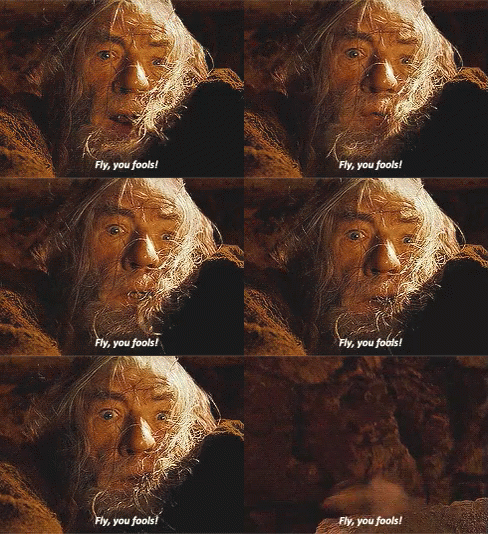
    But the main drama it fails to capture is a well loved trope - "fly you fools.gif".


    The heroic sacrifice. Death at 0 does not really allow a player to turn to their friends and make a Gandalf style proclamation. Whether that often is "allowed" to play out at tables is another conversation (see Matt Colville's video on Surrender) - but it is a fantasy that should be engageable with. Players don't like running away - but they hate leaving someone behind even more. Plus that requires consensus which is even more unlikely in that situation. But if someone is going to die - no way to prevent it - then they are able to do a heroic sacrifice without other players attempting to aid their character.

2) Player Engagement:

    This is more of a knock against death saves (ala 5e) - which is the player is in a state of "not playing." I think being knocked out is valuable, and should increase tension - but if turn lengths are anything longer than a few minutes - than tension begins to dwindle.

    This is very much not to say that turn skip mechanics should not exist - they should - but they should create proportionally more tension or drama. I'd also argue that player engagement gets in a weird space when a character dies early in a session. Even if character gen is simple, engagement can drop unless there is an obvious party recruitment method planned or baked into the current adventure. That can also place stress on the DM (getting the player back in the action).

Solution:

    Lol. If I had the perfect solution to death, I'd be writing a game system built around it. I've tried a lot of solutions and so far none have captured what I'm looking for. I think something would require a lingering injury table, but then not taking them out of the fight. I also like the idea that once a character dies - they continue through the fight. But survival is not an option once combat ceases. Similarly, something to where the player hitting 0 receives a mortal wound and will not leave the dungeon alive allows some fun exploration of those tropes. I'm not sure how to graft that onto a ttrpg mechanic though.

    Maybe a system as seen in the board game Eldritch Horror where no character "dies." But once at 0 hp or sanity they retire because their injuries are just too great to attempt to fight the horrors of the world. I like where Knave 2.0 is going - where any spill over from your hp is taken as injuries which begin to fill up inventory slots. At 0 inventory slots - death occurs. In abstract this really isn't very different - but it does feel different.

    If anyone has any suggestions especially ones that have an attempted solution to enable heroic sacrifices please share!

Wednesday, November 10, 2021

The Return of the Table

Working on blogging more, and I recently listened to the Lazy D&D Talk Show by Mike Shea (SlyFlourish) [link here] where he touched on an interesting topic: Is running a game online easier than in person? He brought it up in the context of physical accessories and how assembling, painting, and procuring (etc etc) takes sooo much time whereas he can just drop a map in a VTT program and some tokens and bam good to go in under 10 minutes.

He is right. If you are running a published WOTC adventure it is easy to just drag and drop maps. It is also easier to just slide into a computer chair compared to getting in a car and driving somewhere. The barrier of entry is just less - no question.

However, the table has something else to me that makes it less "draining." It is the ritual. The social connection that looking at people behind a screen just doesn't have. It feels like more of a chore to drag and drop maps on a VTT. I also feel way more pressured to have more presentation in a VTT because I have to compete with all the other distractions players face. Multiple monitors, multiple tabs, other people in the area, pets - all are things that compete with a DM.  One of my groups folded because the table dynamic of being online just was not conducive to good D&D.  

I also feel that DM'ing online prevents coalition building. Only 1 person (generally speaking) can talk at a time. Because of this, each player who has an opinion on a course of action must wait to vocalize this. In person games allow for side conversations. Thus if there are 4 players, 2 can be interacting with the DM, while the other 2 are coming up with the plan. The planners, then have an idea that they can pitch to the other two. Online this "preplanning" cannot occur which slows down decision making. 

I'm not sure exactly what my overall point is here other than to say I think DM'ing online is a chore for me. It burns me out way faster and this is coming from someone who almost exclusively ran/played online for a majority of my ttrpg experiences. The last thing I'll mention is that DM'ing in person has an element of magic that a screen just cannot capture. Seeing a table erupt with excitement or watch as a d20 clatters around the table only to land on a 20 [or a 1!] simply cannot be replicated online.  

 If anyone has strategies to increase enjoyment of DM'ing online I would love to hear them!

Next up, I'm working on a small random table of antagonists!

Thursday, March 11, 2021

Naming the Party


Everyone agrees a +1 sword—without anything more—is dull.

Everyone agrees a dungeon—without flavor—is boring.

So why does the Party not have a name?


Giving the Party a name is similar to wielding "The Sunblade" or delving into "The Tomb of the Serpent Kings." It contains a wow factor.

There are plenty of ttrpg groups that stream with party names.

  • Critical Role has Vox Machina and The Mighty Nine
  • Acquisitions Incorporated
  • MCDM has The Chain, The Revenant Vow, The Shield of Gravesfold
  • and there are many many more examples.

Naming the Party has some amazing benefits such as:

  • Increased Group Unity (there is now a clearer defined "us")
  • Ability to confer rewards that are unique to the Party (ex. +to charisma checks or bonuses to reaction rolls against those who have heard of the Party's accomplishments).
  • Provide an easy in game reason for a new PC to seek the group out in the event of a player character death

Despite so many indications that there is power in a name, I don't think it is a prevailing part of gaming culture.

There is definitely pressure on a group to pick "the right name." A DM could also worry the players won't take the matter seriously and chose something like "Power Rangers" or "The Mighty Five." These types of names could ruin immersion in something other than a beer & pretzels style game. Fear over this does not mean you should instantly dismiss the concept. I think there are two strong starting options to guide towards a name—although I'm sure more are available to those with more creativity.


Team Unity 10/10 — Go go name the party! 

  1. The Skyrim Cart
  • Have the campaign begin by the characters selecting their name. They can be in a tavern if you like tradition. I've done this on a boat, sailing into the "starting city." Actually I've done this a few times starting on a boat . . . what can I say? If it works it works. The players are together for whatever reason you've determined in session 0. Maybe they are friends setting off for adventure! Maybe an organization? Maybe just a band of adventurers? Regardless, the populace is more apt to spread the word on whatever deeds the Party achieves if there is a name to associate them with. Regardless, once the name is selected—something should just HAPPEN. Orcs attack! A tavern brawl breaks out! The kraken surfaces and threatens to drag them down to the depths!  Reward the achievement of unity by having a big set piece. 
  1. The Indiana Jones
  • Start the players in a situation where the need to accomplish something before returning to town (or their safe haven).  It should be open ended enough where the players have a ton of freedom on how to respond with their starting goals.  This might be a good spot to introduce a secondary antagonist or the primary antagonist's lieutenant (maybe not in a combat encounter, just talking between the bars of a portcullis!).  The Party can then return to town successful (perhaps not 100% success, even Indy lost to Belloq) and a town guard could ask "Wow great work, what do you call yourselves?" The players now have an event to base their decision off of—something to help spark ideas.

Either way, the DM should give the players an opportunity to discuss things and even feel free to chime in and guide some discussion. If the DM hears a good idea—say so!  This can help the players feel reassured in their decision.  Additionally, the entire table should feel some degree of comfortableness (is this even a word?) with the name.  This includes the DM. 

The name should also be reinforced through repetition. NPC's should use the name. Comment on it. And love it.  The reinforcement should be that the name is good and that the name is important. This also goes for antagonists. I would not recommend "making fun of" the name—as you risk the players feeling like it was dumb to put themselves out there.  

Finally I want to comment on the idea that the players will not unify.  This is not a problem that results because you asked for a group namerom.  This may be a problem with the player's group dynamic.  Being able to see this and discuss solutions as soon as possible will result in less future problems.  If they players aren't going to play nice together, then perhaps a boardgame is a better option?  Or a different group? 

Having these discussions can also reveal characters that will not gel together.  This is probably a tangent for a session 0 blog, but simply giving the group a similar goal does not mean the characters will mesh.  Depending on the prevalence of inter-party roleplay, the conflict may not even arise until well into the game.  If they can't compromise on a name—they will not be able to compromise during any major point of tension.  And that is something I would want to know as soon as possible.

That's my thoughts, really trying to get back into blogging, not sure what topic I have in me next—maybe a reaction to a zine I recently read ("Barrow Keep") or discussing death at 0 hp and death saving throws.

Wednesday, March 10, 2021

The Usefulness of Narrow Hallways

Short blog post—having a lot of inspiration and want to keep the magic rolling! 

Today I want to highlight the usefulness of using hallways that are only five feet (one movemenet square) wide.


It is actually pretty telling how many iconic fight scenes take place in narrow hallways

The first time I built a dungeon that contained a long narrow hallway with a few attached rooms (ala The Raid), my more tactical players were very very frustrated. They didn't feel they had room to maneuver or make "interesting" combat decisions. Instead, they fought a mind flayer in an exceedingly awkward manner.  The door to a room was held by a corpse piloted by an intellect devoured corpse and the mind flayer comfortably stayed back—firing psychic blasts.  The Party was overwhelmingly melee based and were blocking each other from attacking anything.  It was chaos.

One character died and it was the closest I've even been to having a TPK.  

Afterwards, some of my players commented that they wished the hallways were simply 10 feet wide to allow them to have "options for tactics." Oh, and the doors should have been 10 feet wide. That way the Party could just pass through and hit the mind flayer.

I disagree.

Not every dungeon (read: space where combat could occur) was designed for combat. Think about how many narrow hallways some buildings have.  There are numerous reasons that those hallways were built that way. This should signal that this area is something different. Something that just doing the bog-standard attack action will place you at a disadvantage.  It is akin to fighting during inclement weather, in an anti-magic sphere location, or other obstacles that force a tactic change. The Party should never be able to use the same operating procedure in every fight.  There is no drama to be had there.

One way to prevent that—is to prevent their movement.

This fight is made much more tense because of the narrow cramped hallways!

Sometimes you want the Party to be cramped. Create the feeling that progressing forward means marching order matters.  Sure this can be handled through traps, but fights also spice things up. 

Monsters should also take advantage of this. After all, the dungeon is their home. It should reflect their lifestyle.  For example, a dragon whose breath comes in a line may have a hallway of similar dimensions to pre-attack the Party before they reach its lair. Just a opening salvo. To scare away (or potential kill) intruders.  Sure the Party could heal and recover from any damage taken.  But a message is sent.  The dungeon is hostile. 

All that said: use narrow hallways!  Make the dungeon space hostile to force tactic changes even if the players may initially feel frustrations thier standard operating procedure is disrupted.  Finally, keep in mind that whatever dwells in that space should use it to their advantage!

Monday, March 8, 2021

Make Experience Points Work for You

Best Advice Upfront: A DM should use an experience point system to incentivize the playstyle(s) they want to see in the game.

Experience points are a perfect carrot to guide players towards the DM's "favored" playstyle. The players always reflect their style by making choices and decisions while the DM can provides mechanical "rewards" for making those choices within a certain style. Viewed this way, it is a great way for a table to form a solid middle ground of how the game will be played.

I won't rant on why I dislike milestone leveling. I only mention it is because it rarely communicates to the players what playstyle will get rewarded. If the milestones are hidden behind the DM screen, players can begin to feel like they are trying to just guess at what the DM wants to happen.

A lot of OSR games do experience for gold. This is fine. It conveys the goal of the game is to go where there is gold and obtain it.  You probably won't have a high level of roleplaying (or at least—less) as it is not rewarded. Only pursuit of profit matters. 

[sidenote: "Only pursuit of profit matters" actually sounds like a fun style of game ala Acquisitions Incorporated]

That being said,  experience for gold doesn't do it for my OSR game.  I want to reward roleplay, making decisions in character, and the players preplanning the next session. I still want dungeons, so obtaining gold is also important.  But just recovering it isn't my main intention.

My DM, (@Painted_Squid on twitter, seriously check him out) began implementing the experience system from Mouse Guard in 5th Edition. Mouseguard gives experience for acting on your beliefs, acting on your trait, and accomplishing your goal. Over time he's made numerous adjustments to have it mesh with 5e and I hope at some point he publishes his trial-and-error thoughts because wow.

With all that in mind, here is my experience system using the mouseguard framework! Experience is calculated at the end of session, with achievement being a binary "if yes, then xp."

  • 1 xp per 1 Gold Spent

    • I want the party to go to dangerous places were they can find gold. But I don't want it hoarded. Thus, make them spend the gold. All my players started in 5th Edition with milestone leveling. Specifically, the epic quest milestone system. They never focused on acquiring titles, improving property, or having hirelings to perform services. In a game where those assumptions are shared by all players, just xp for acquiring gold might be okay.
  • 100 xp for Acting on Their Trait (once per session)

    • A characters should have a consistent and flavorful personality. This rewards players who embody their characters trait during the game.  I generally dislike someone who just RP's as the best version of themselves. I also want to draw players towards a better understanding of each others characters. If someone writes "bashful" as their trait, any RP done by that player will be more easily received as being "bashful" —without needing the skill required to audition for Critical Role. It also allows the table to reflect on choices and RP done by all players, as this review is performed at the end of a session. The constant session to session affirmation of a players personality is further reinforcement. I have another blog post in me re: traits, but I'll save that for another time.
  • 100 xp for Accomplishing Their Goal

    • At the end of a session, I have my players fill out a single goal they would like to accomplish next session. It must have a "will they/won't they" element. I'm not always super strict on this because the true purpose of this is for me to vaguely plan next session without having feeling unprepared. This doesn't mean they are beholden to these goals & if something comes up that changes their direction I'm not upset. But I can at least know my pre-session prep is generally covering what they are intending to do, In a pure sandbox game with no "overarching plot," I would be nervous if I had little clue or insight into their plans, as games on VTT's come with certain expectations regarding battlemaps and other visual aids.
  • 3 Awards, Each Worth 100 xp: Best RP/Overall RP/MVP

    • I don't want the number of awards to equal the player count. This is because they are not meant to be just divided equally. I want players to want these. If everyone gets them, then they are glossed over and have no impact. That being said, if the players tacitly (never said verbally) ensure no one gets two and the xp is usually divided around the players, I'm not stressed. The purpose of this is still fulfilled.
    • Lastly, It does favor some players over others initially. It is true that the more outgoing people are likely to get awards for RP. However, it can also be used to highlight players who display more subtle or unrecognized RP. Being rewards could even encourage that player to feel more comfortable occasionally RP'ing in more outgoing fashion.
    • People like awards and the feeling of being recognized. This gives players the opportunity to be recognized at the end of a session. It turns into a mini recap in a way of things the players found important. They are purposefully vague to allow the players to reward activity that they enjoy that other players did in the session. Sometimes, I also weigh in if I think a moment was subtle or particularly impactful to me. The term "MVP" may seem loaded, but it is intended to cover a player who "provides a critical contribution to allow the party to progress." My current players understand this terminology, but I could see the being a future point of change.
  • 50 xp for Initiating a Chat Message to Another PC While In-Character (once per session)

    • This reward I'm not sold on yet—but it serves a small purpose. Part of why I love in-person games is the side conversations. It reduces pressure on me as a DM because I can resolve an individual's situation while other players plan or RP. Online games lack this mechanic unless you have breakout rooms—which are tedious and more work. For an in-person game this would be cut.
  • 1 xp for a New Character per 1 Gold Spent on the Dead PC Funeral

    • Dying sucks. It can be dramatic, intense, and worthwhile. But at the end of the day—that player's progression is reset. This rule is intended to help with the suck. The other goal it accomplishes is to prevent the other players at the table from "moving on" quickly. Too often at the table I've seen a player die and then feel like their death had no meaning for the other players. I don't think anything will cause another player to feel the loss in the way the player whose character died wants them to feel. However, with a mechanic designed to honor the fallen, there can be a moment to talk about the fallen reverently knowing this will power up the new party member. 
    • It also makes sense in universe. More powerful people are going to want to work with/travel with those who honor their dead with opulence. It shows to the world that the Party is successful (acquiring lots of gold and not feeling financially insecure to spent it). It also provides an opportunity for the new character to be introduced. For example, "I'm sorry to hear about your friend, . . . are you looking for a hand to accomplish XYZ?"

This is a work-in-progress and likely will never be finished. But I hope it inspires others to try to tweak and experiment with experience points.


Sunday, November 22, 2020

Session 0

Very excited to make the leap into blogging!   

A bit about me: I am a cat father, husband, and lawyer.  Most important for the blog: I am also a dungeon master and avid reader of ttrpg's.  My experience with ttrpg's began with 5th Edition D&D in 2017, where I started as a DM doing a Lost Mines of Phandelver game.  

After running around 120 sessions of 5th edition—I realized the parts of fantasy ttrpg's that I engaged with the most required a lower magic setting.  I really struggled having to handle rampent spellcasting being assumed.  Additionally, my style of DM'ing does not mesh with the "make an insight check" culture associated with 5e.  

My futile attempts of retooling and houseruling 5e caused me to become frustrated with the system.  After being introduced to Knave, Dungeon Crawl Classics, Old School Essentials, and other OSR systems—I fell in love!

Majority of my posts will be about my thoughts as a DM and suggesting tools for players and DM's alike to create a more enjoyable experience for all at the table.  I think there are a lot of different systems brought to the table by a lot of indie/DIY ttrpg authors that more people should experience!

I'll also try and document some session reports here and start a running list of "lessons learned" from the game—very similar to the Chris Perkins sheet of old.  I'll also occasionally review adventures I ran or extensively read.    

Finally, I co-host a 15 minute DnD podcast discussing the weals & woes of being a DM.  If you are looking for a short podcast that attempts get straight to the issue—check us out: https://anchor.fm/zoneofhottruth.   

If you have any suggestions about topics, feel free to contact me on twitter @ItsEricReitz

Hope you enjoy! 


Eric

2024 Goal Progress

 It has been 9 days and I'm already posting an update!  Played ttrpgs: 2/24  Worlds Without Number* Mythic Bastionland^ Fox Curios: Floa...